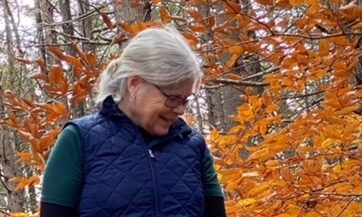
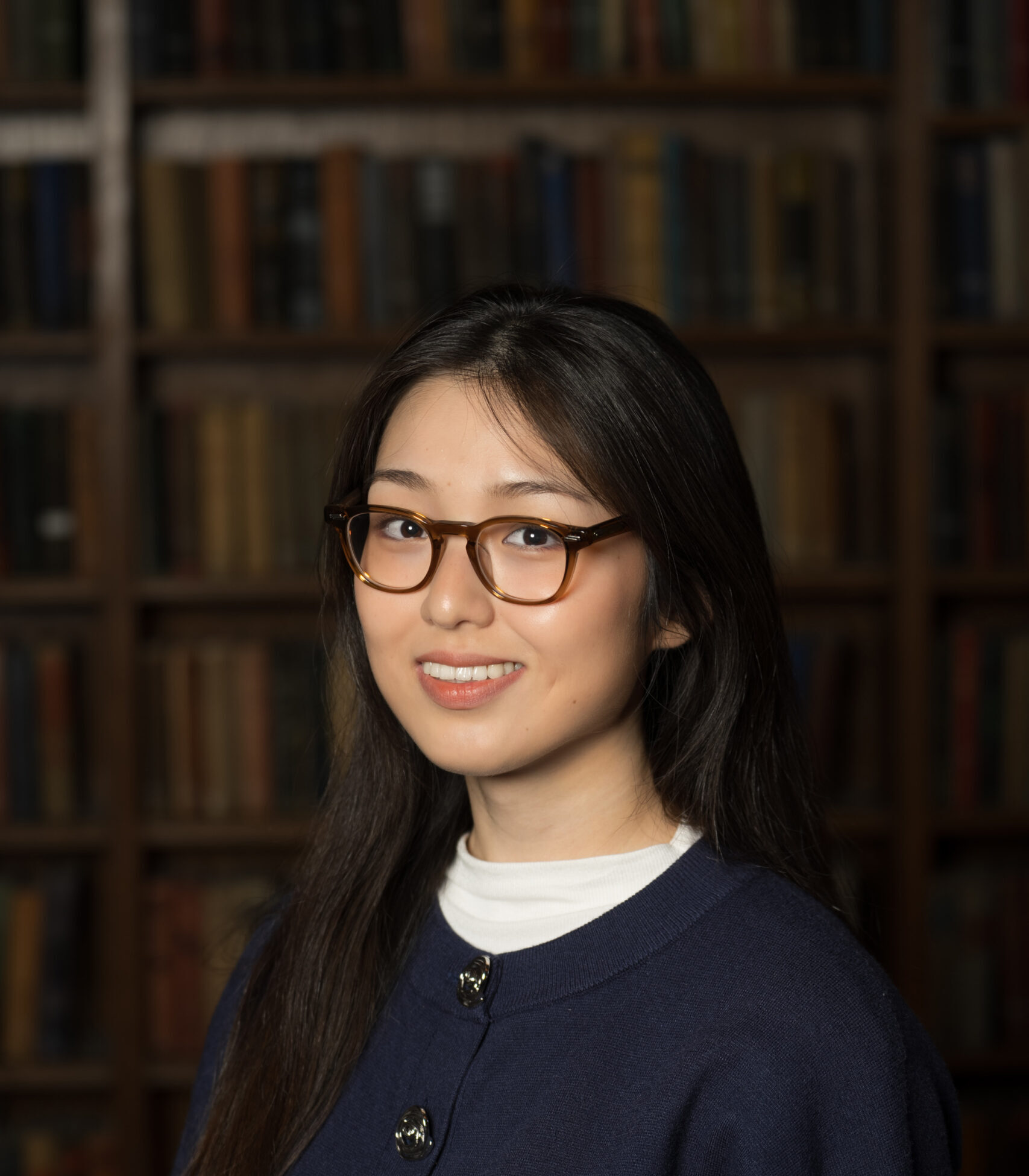
Anna-Alexandra Fodde-Reguer (she/her), or Anna, has been the Chinese studies librarian at the University of Pennsylvania since 2023.
 What was your position title and workplace when you worked in East Asian Studies librarianship? How long have you worked there?
I was hired in 2023 to be the new Chinese studies librarian at the University of Pennsylvania, as my predecessor is now the Director of the Zilberman Family Center for Global Collections. I also work with the Mongolian collections at Penn.
Previously, I was a research and instruction librarian at Haverford College, a small liberal arts college outside of Philadelphia. Among my responsibilities at Haverford was supporting the department of East Asian Languages and Cultures. Working for both a small college and a large Ivy League institution taught me a lot about librarianship, and I am fortunate to have a job where I am encouraged to keep learning.
How did your journey in working with East Asian libraries and collections begin?
I spent many years researching in East Asian libraries in my graduate school days. The Asia library at the University of Michigan was where I really received my training. As a PhD student living in Taiwan and China, I was fortunate to visit and use many libraries and see how they differ from the ones in North America. When I was writing my dissertation and living in Beijing in 2012, I had a hard time accessing materials at the university I was assigned to and came back to the US feeling very dejected. I reached out to the head of the Asia library at the time, Dr. Jidong Yang, and a few weeks later, the books I requested were waiting for me at the pickup desk at Hatcher library. That was an epiphany for me.
I finished my PhD and became a Visiting Assistant Professor for a year, burned out, and sought an “alt-academic” job. I was very fortunate that the Librarian of Haverford College took a chance and hired me. I worked on an MLIS in the first two years of my job and completed it with a newborn baby in my lap.
What did you enjoy most about your career in East Asian librarianship?
When I was hired at Haverford College, I was very interested in supporting students (especially Senior Thesis students) and aiding in exploration and discovery. But I really missed using Chinese every day. I missed reading Chinese, learning about China, and talking about China with anyone who would listen. I think my longing for China and Taiwan pushed me to pivot my career once again. The position at Penn came at a good time for me because I had learned so much about the field from my days at Haverford but was ready for more Chinese challenges.
The advanced research questions I receive now are like tiny mysteries and I get to hunt for clues. These questions—big and small alike—are ultimately an opportunity to learn about a sub-field, and I relish this side of our field. Thankfully, I still interact with students and teach about advanced research skills, but now I do so many other things as well. It is indeed my dream job.
What did you regard as your achievements/accomplishments in the field?
Due to various opportunities, I learned and added to the field in my own way. For example, I was partially responsible for the identification and digitization of a small collection of propaganda posters in Haverford’s collection. None of the staff read Chinese at the time, so I was able to use my skills to develop exciting projects for student workers. We created a digital site and curated as much as possible with researchers in mind. In addition to the site, I co-wrote an article in the journal ASIANetwork Exchange about using such materials in educating undergraduates about Chinese history and culture.
As an early China scholar, I keep up with the scholarly field because it makes me a better librarian. As such, I write book reviews, am sometimes a peer-reviewer for academic journals, and try to work closely with early China PHD students and support them in whatever ways I can.
What change(s) and trend(s) in East Asian librarianship had you witnessed and envisioned?
It is no surprise that digital projects and tools are the biggest changes I witnessed in the past 20 years. Digital humanities projects became very popular about ten years ago and is a trend that still sparks so much interest among students.
When I was a graduate student, I always wished for a seemingly futuristic option where I could look up a word with ease and convenience. I recall purchasing a digital dictionary in Taiwan around 2008 that excited me because I could write characters on a small pad with a stylus. I had to rush when I wrote characters though because it was made for native speakers to look up Japanese and English. It took me a while to keep up with the necessary speed!
Fast forward to 2026 where there are too many dictionary app options and most of them allow you to write a character in the app for identification. This really changes things for non-native researchers. Now, the onset of AI will transform things once again, and we are all struggling to find ways to adjust and adapt.
Tell us about your favorite book or series:
This is too hard. I will say my favorite books in 2025 were the historical novel Taiwan Travelogue (I read it in English with the Mandarin edition on the side), the horror fiction The Buffalo Hunter Hunter, and the fantasy doorstopper The Raven Scholar.
Tell us some fun facts about you:
I have two children and two grey-and-white cats and live in a former carriage house in Philadelphia. I love plants and used to collect orchids before the cats moved in. Now I spend a lot of time trying to keep the cats from destroying my orchids.